Can You Really Do Mold Remediation Yourself?
The short answer is yes — for most small to moderate mold problems. The EPA guidelines state that homeowners can handle mold remediation themselves when the affected area is less than 10 square feet. Many mold situations in Greater Atlanta homes fall well within this range: a patch of mold under a bathroom sink, mold on a basement wall after a small leak, or mold in a window frame from condensation.
The key to successful DIY mold remediation is having the right knowledge, the right safety equipment, and the right drying tools to ensure the mold does not return.
Understanding Mold Types in Georgia Homes
Not all mold is the same, and understanding what you are dealing with helps determine your approach:
Common household molds in the Atlanta area:
- Cladosporium — olive-green to brown, commonly found on fabrics, wood, and HVAC systems. Generally less hazardous but can trigger allergies.
- Penicillium — blue or green, spreads quickly on water-damaged materials. Common after flooding or leaks.
- Aspergillus — varies in color, found on walls, insulation, and paper products. Some species produce mycotoxins.
- Stachybotrys (black mold) — dark green to black, slimy texture, grows on materials with high cellulose content like drywall and wood. Requires consistent moisture and is often found after prolonged water damage.
Regardless of the type, the remediation approach is the same: remove the mold, remove the moisture source, and dry the area thoroughly.
Essential Safety Equipment
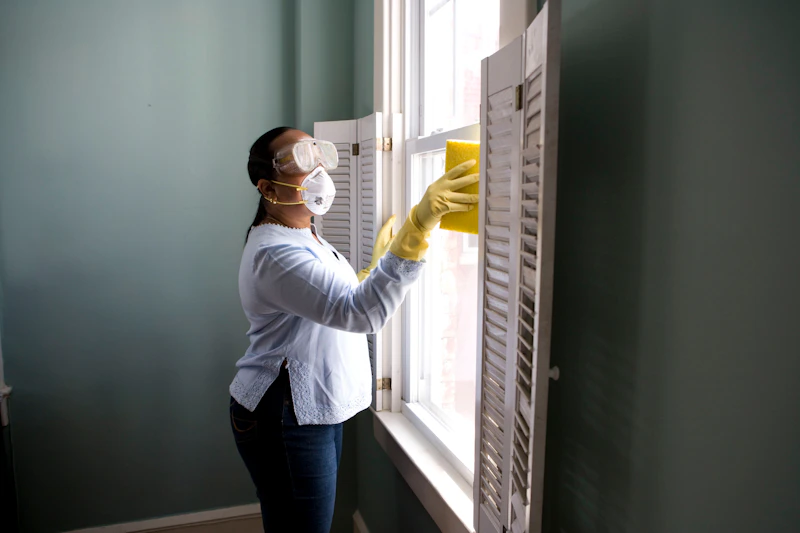
Mold remediation releases millions of microscopic spores into the air. Proper personal protective equipment (PPE) is non-negotiable:
| Equipment | Minimum Standard | Purpose |
|---|---|---|
| Respirator | N95 (P100 preferred) | Prevents inhaling mold spores |
| Gloves | Rubber, extending to forearm | Prevents skin contact |
| Goggles | Non-vented safety goggles | Prevents eye irritation |
| Clothing | Disposable coveralls or old clothes | Prevents spore transfer |
| Footwear | Rubber boots or shoe covers | Prevents tracking spores |
All PPE should be removed and bagged before leaving the contained work area.
Step-by-Step DIY Mold Remediation
Phase 1: Assessment and Planning
Before starting any work:
- Identify the moisture source — mold cannot grow without moisture. Find and fix the water source first, whether it is a leaky pipe, poor drainage, condensation, or a previous flood.
- Assess the scope — measure the affected area. If it exceeds 10 square feet, or if mold is inside walls or HVAC systems, consider professional help.
- Document everything — take photos for insurance purposes before starting remediation.
- Gather supplies — PPE, plastic sheeting, painter's tape, HEPA vacuum, antimicrobial cleaner, garbage bags, and drying equipment.
Phase 2: Containment
Containment prevents mold spores from spreading to clean areas of your home:
- Seal the doorway to the affected room with 6-mil plastic sheeting and painter's tape
- Cover HVAC vents and returns in the room with plastic
- If possible, create negative air pressure by placing a fan in a window blowing outward
- Lay plastic sheeting on the floor to catch debris during removal
Phase 3: Removal
Porous materials (drywall, insulation, carpet, ceiling tiles):
- These materials cannot be effectively cleaned once mold has penetrated them
- Cut and remove drywall at least 2 feet beyond visible mold — mold roots extend further than what you see
- Double-bag all removed materials in heavy-duty garbage bags
- Seal bags inside the containment area before carrying them through your home
Semi-porous materials (wood studs, joists, subfloor):
- Sand or wire-brush the surface to remove visible mold
- Clean with antimicrobial solution
- Apply mold-resistant primer or encapsulant after drying
- These materials can usually be saved if structurally sound
Non-porous materials (concrete, metal, glass, hard plastic):
- Scrub with antimicrobial solution and a stiff brush
- Rinse and allow to dry completely
- These materials clean up well and rarely need replacement
Phase 4: Cleaning
After removing contaminated materials:
- HEPA vacuum all surfaces in the work area — walls, ceiling, floor, and any remaining items
- Wet-wipe all surfaces with antimicrobial solution
- HEPA vacuum again after surfaces have dried
- Clean or dispose of any contents that were in the affected area
Phase 5: Drying (The Most Critical Step)
This is where most DIY mold remediation efforts fail. If the area is not dried thoroughly, mold will return — often within weeks.
Professional drying equipment is essential:
- LGR dehumidifiers pull moisture from the air far more effectively than consumer units
- High-velocity air movers direct airflow across wet surfaces to accelerate evaporation
- Moisture meters verify that all materials have reached safe moisture levels before you stop
Run drying equipment continuously for 3-5 days minimum. Do not stop until moisture meter readings confirm all materials are below safe thresholds.
Jar2 Restoration's equipment packages include everything you need for the drying phase, starting at $349 with free delivery across Greater Atlanta.
Phase 6: Verification and Rebuilding
- Take final moisture readings of all affected areas
- Visually inspect for any remaining mold
- If the area passes inspection, you can begin rebuilding
- Use mold-resistant drywall and mold-resistant paint for the replacement materials
- Consider improving ventilation in the area to prevent future moisture problems
Common DIY Mold Remediation Mistakes
Painting over mold: Paint will not kill mold. It will grow through the paint within weeks.
Using bleach on porous surfaces: Bleach kills surface mold on non-porous materials but cannot penetrate porous materials like wood and drywall. The water in bleach actually feeds mold roots deeper in the material.
Not fixing the moisture source: If you remove mold but do not fix the leak, condensation, or drainage issue that caused it, mold will return.
Inadequate drying: Using household fans instead of professional air movers and dehumidifiers leaves residual moisture that allows mold to regrow.
Skipping containment: Without containment, mold spores spread throughout your home during removal, potentially creating new mold problems in previously clean areas.
Cost Comparison: DIY vs Professional Mold Remediation
| Service | Professional | DIY with Jar2 Restoration |
|---|---|---|
| Assessment | $300-$600 | Free (visual inspection) |
| Containment setup | $500-$1,000 | $50-$100 (plastic/tape) |
| Mold removal | $1,500-$4,000 | Your labor |
| Drying equipment | $500-$1,500 | $349-$599 (full package) |
| Air quality testing | $300-$600 | Optional |
| Total | $3,100-$7,700 | $399-$699 |
For a typical mold remediation job in the Douglasville area, DIY saves $2,700 to $7,000.
Get Started
Jar2 Restoration provides the professional-grade drying equipment that makes DIY mold remediation effective. Our packages include air movers, LGR dehumidifiers, moisture meters, and free expert support.
Call (770) 765-6036 for same-day delivery throughout Greater Atlanta.
Need Water Damage Restoration Equipment?
Jar2 Restoration delivers professional-grade equipment anywhere in Greater Atlanta. Flat-fee pricing, free delivery, and expert support.